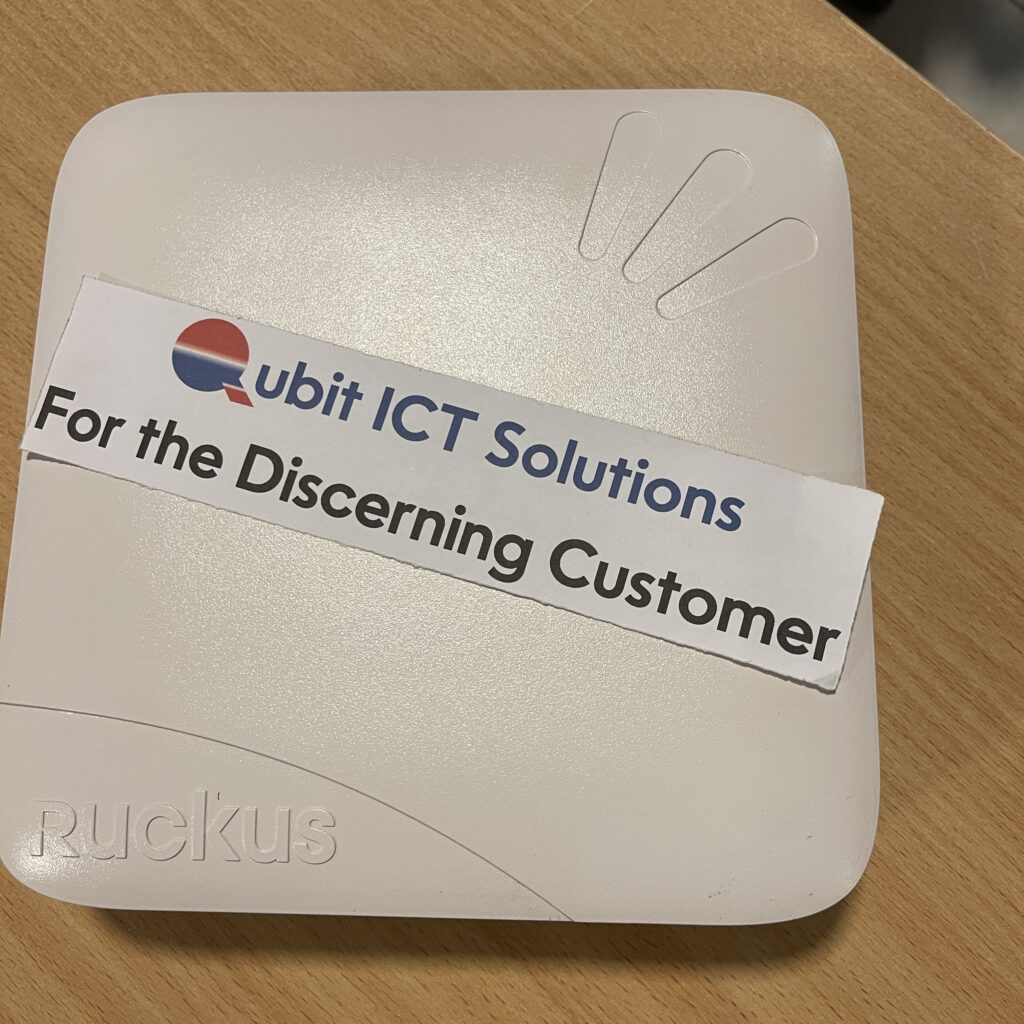
Why the Ruckus R700 Still Makes Sense
In a market obsessed with the next Wi-Fi generation, smarter networking isn’t always about buying the newest standard.
In the rapidly evolving landscape of wireless networking, the buzz is almost always about the “next big thing”—currently Wi-Fi 6 and Wi-Fi 7. However, for many businesses in Kenya, Uganda, and Tanzania, the latest standard isn’t always the smartest investment.
At Qubit ICT Solutions Kenya, we believe in performance that meets your reality. That is why the Ruckus R700 (ZoneFlex) remains a heavyweight contender in 2025 for organizations looking to upgrade their connectivity without the “bleeding-edge” price tag.
The Ruckus R700 proves that smart networking isn’t always about the newest Wi-Fi standard. Its BeamFlex+ intelligence, high-density capability, enterprise reliability and efficient infrastructure requirements make it a compelling option for East African organizations seeking dependable wireless performance without unnecessary replacement costs or technology-driven spending.
Why the Ruckus R700 Still Dominates
The real question isn’t whether newer wireless standards exist. It is whether an organization gains enough practical value from them to justify the cost of replacing proven enterprise hardware.
Why the Ruckus R700 Still Dominates
While it lacks the “Wi-Fi 6” label, the Ruckus R700 is built on enterprise-grade architecture that outperforms many modern entry-level Wi-Fi 6 routers. Here is why it remains a serious contender:
BeamFlex+ Intelligence
Adaptive antenna technology designed to improve signal direction and reduce interference.
High-Density Performance
Enterprise architecture designed for environments where many devices need connectivity simultaneously.
Infrastructure Efficiency
Performance that can make sense where replacing an entire network stack isn’t justified.
BeamFlex+ and the Battle for Clean Air
Wireless performance is shaped by the environment in which an access point operates—not simply the maximum speed printed on its specification sheet.
1. Patented BeamFlex+ Technology
Most access points blast Wi-Fi in a 360-degree circle (omnidirectional), which wastes energy and creates interference. The R700 uses BeamFlex+, a smart antenna system with over 3,000 unique antenna patterns.
It automatically steers the signal toward the client and away from interference. In busy East African urban centers like Nairobi, Kampala, or Dar es Salaam, where the airwaves are crowded with competing signals, this “interference mitigation” is more valuable than raw theoretical speed.
The practical advantage
In dense environments, controlling interference can matter just as much as increasing theoretical throughput.
Built for High Density
Enterprise wireless begins to reveal its value when the number of connected clients stops being predictable.
2. Built for High Density
The R700 was engineered for places like airports, universities, and hotels. It can handle up to 512 concurrent clients. While a cheap Wi-Fi 6 home router might struggle once 30 people connect, the R700 keeps a steady flow for hundreds, making it perfect for:
Cost-Effective Performance
A wireless upgrade is rarely just about the access point. The infrastructure behind it determines the true cost.
3. Cost-Effective Performance
A brand-new Wi-Fi 6 setup requires not just expensive APs, but often an upgrade to your PoE (Power over Ethernet) switches. The R700 is highly efficient; it delivers full 3×3:3 MIMO performance on standard 802.3af PoE, meaning you can likely use your existing infrastructure.
Qubit ICT Solutions: The Budget-Friendly Professional Choice
Value engineering is not about buying the cheapest component. It is about matching infrastructure investment to actual need.
Renewed Value
Renewed Value: We often provide Renewed (Refurbished) Ruckus R700 units. These are enterprise-grade machines that originally cost upwards of KES 100,000, now available at a fraction of that cost. You get a premium enterprise grade Access Point for a half the shelf price when new. The devices are still available new but the prices have been significantly reduced.
Reliability Over Hype
Reliability Over Hype: Most mobile devices in Kenya and Tanzania today are still Wi-Fi 5 (802.11ac) or older. Investing in Wi-Fi 6 often provides zero benefit for these devices. The R700 is optimized specifically to squeeze every bit of speed out of the phones and laptops your team actually uses. We have deployed these devices in homes where a single AP covers 100ft by 100 ft lot area including the outdoors.
Scalability
Scalability: Whether you are in Nairobi or Arusha, the R700 can be deployed as a standalone unit or managed via a Ruckus ZoneDirector, allowing your network to grow as your business does.
The Numbers at a Glance
Specifications matter most when they explain a real-world networking decision.
| Feature | Ruckus R700 | Standard Budget AP |
|---|---|---|
| Max Clients | 512 | ~50-100 |
| Antenna | 3,000+ Patterns (BeamFlex+) | Fixed/Omnidirectional |
| Throughput | 1.3 Gbps (5GHz) | Varies |
| Interference | 15dB Mitigation | Minimal |
The point isn’t simply Wi-Fi 5 versus Wi-Fi 6. It’s fit.
Conclusion: Smart Networking for East Africa
The goal of a great network isn’t to have the newest version number; it’s to ensure that when a client walks into your office in Dar es Salaam or a student logs in at a campus in Kampala, the internet just works.
For many organizations, the most meaningful wireless upgrade isn’t necessarily the one with the newest specification. It is the one that improves coverage, handles congestion, works with existing infrastructure and delivers a measurable improvement without forcing an unnecessary network replacement.
The Ruckus R700 offers a level of stability and high-density performance that modern budget-grade Wi-Fi 6 units simply cannot match.
Looking to upgrade your network on a budget?
Explore the Ruckus R700 and see whether its enterprise-grade wireless performance is the right fit for your environment.